One bad crimp caught on the production floor costs pennies. That same crimp caught six months later in a NHTSA field recall can cost thousands of dollars per vehicle, plus the reputational damage that follows a Tier 1 customer through their own audit chain. The math on prevention versus recall recovery is not close.
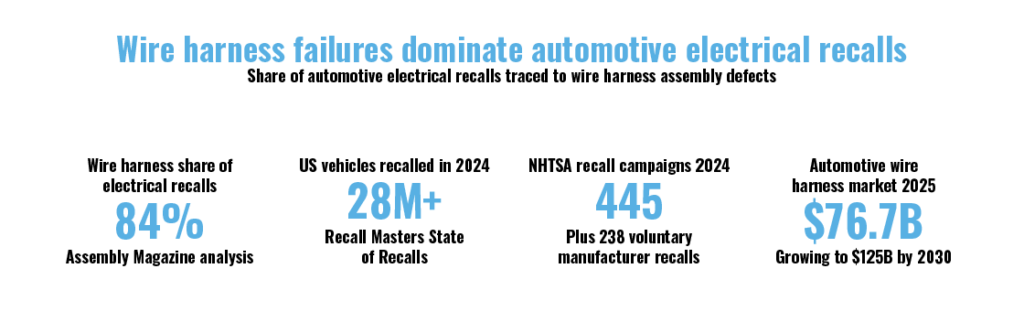
Sources: Assembly Magazine wire harness failure analysis; Recall Masters 2024 State of Recalls report; Grand View Research automotive wiring harness market forecast.
The automotive industry recalled more than 28 million US vehicles in 2024 across 445 NHTSA-mandated campaigns and 238 voluntary manufacturer recalls. According to Assembly Magazine analysis, wire harness failures cause 84 percent of automotive electrical recalls. That single statistic frames the entire quality control conversation for harness suppliers in 2026.
What Actually Causes These Recalls
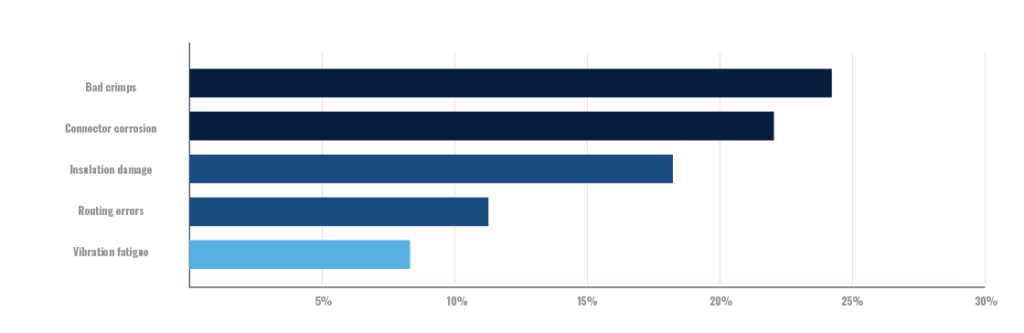
Wire harness assembly defects don’t fail one way. They fail in several predictable, well-documented ways that experienced quality engineers see repeatedly across programs:
- Bad crimps with incorrect height, insufficient compression, or poor strand contact that pass end-of-line testing but fail under vibration or thermal cycling in the field
- Connector corrosion at splice points and terminal interfaces, often from water intrusion or dissimilar metal contact
- Insulation damage from improper routing, over-taping, or contact with sharp edges
- Routing errors where harness bundles were assembled correctly but installed incorrectly, creating chafe points against moving parts
- Vibration fatigue at connection points that survived initial testing but broke down over 50,000 or 100,000 miles
The Ford Ranger recall of 140,201 vehicles in 2026 was traced to sun visor and headliner wiring that had been incorrectly routed or wrapped with excessive tape, causing wire degradation and potential electrical short at the A-pillar. The Polestar 3 recall the same year covered water damage to electrical connectors between the engine bay and front bumper cable harnesses, causing loss of power steering assist.
Every one of these root causes traces back to something that either the harness assembly process or the quality control process failed to catch.
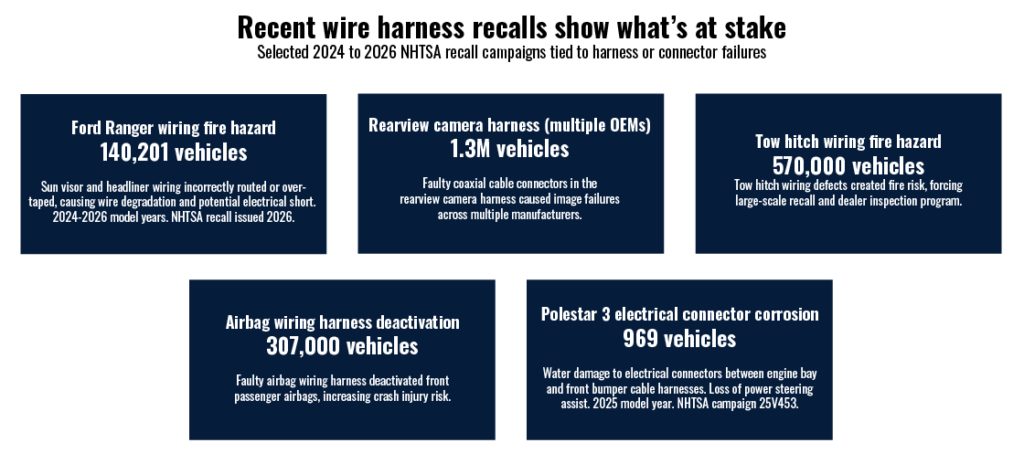
Sources: NHTSA recall database (2024-2026); Altium wire harness failure documentation; IndexBox reporting on Ford Ranger recall.
The True Cost of a Recall to a Tier Supplier
The direct cost of a recall to the OEM gets most of the media attention. But the ripple effects on Tier 1, Tier 2, and Tier 3 suppliers are where the real financial pain lives:
- Direct recall repair costs per vehicle, typically $500 to $3,000 depending on complexity, that get charged back through the supplier contract chain
- Production line disruption as new safety builds interrupt scheduled programs
- OEM chargebacks for warranty claims, expedited replacement parts, and engineering investigation time
- Loss of future business when a Tier 1 supplier loses program renewal to a competitor after a quality event
- Increased audit frequency for every future program, which raises compliance costs across the entire operation
- Insurance premium increases on product liability coverage
- Regulatory scrutiny including potential NHTSA investigation, TREAD Act reporting requirements, and possible civil penalties
For a Tier 2 harness shop, a single major recall traced back to your product can end the customer relationship. Recovery is possible but expensive, slow, and never complete. Most harness suppliers who lose a Tier 1 customer to a recall never win them back.
The Ripple Effect Across the US Auto Supply Chain
Automotive recalls don’t stay contained to one state or one OEM. The US auto manufacturing base spans a corridor that runs from Michigan and Ohio through Indiana, Kentucky, and Tennessee, and continues into the Southern battery belt in Georgia and South Carolina. Every major OEM program pulls parts from Tier 1, Tier 2, and Tier 3 suppliers across multiple states, which means a single harness defect in a Detroit-built vehicle can trigger recall costs and supplier chargebacks for shops in five or six states simultaneously.
Michigan and the Detroit Three Anchor the Supply Chain
Michigan sits at the center of that supply chain. Detroit-based OEMs including GM, Ford, and Stellantis operate assembly plants and R&D operations that pull from Tier 1 and Tier 2 suppliers across the state and into Ohio, Indiana, and beyond. The $22 billion in Michigan EV manufacturing investment that’s building out through 2028 means a rising volume of new harness programs, new terminal specs, and new recall exposure for the shops supplying them.
The Stellantis Toledo mid-size truck program launching in 2028 will pull harnesses and components from suppliers across Ohio and Michigan. Honda’s Marysville complex draws from a supplier network that reaches into Indiana. Every program launch pulls harness suppliers into new qualification cycles with different specs, different volumes, and different recall exposure profiles.
Kentucky and Tennessee EV Battery Plants in Transition
The Southern extension of the auto corridor has been reshaping fast. Ford’s operations in Kentucky have been in flux, with the company taking sole ownership of the Hardin County BlueOval SK facility in 2026 and retooling it for battery energy storage rather than the originally planned EV battery production for Ford F-Series vehicles. The Tennessee BlueOval City site is now under SK On sole ownership with production timelines shifted to 2028.
That kind of transition creates real recall exposure for harness suppliers. New programs mean new terminal specs, new applicator setups, and new validation cycles happening under compressed timelines. When production ramps back up in a retooled facility, the first year of output carries elevated risk because everyone in the supplier chain is running on new tooling with limited historical data. Kentucky and Tennessee harness shops preparing to quote on the next wave of these programs need cross-section validation built into their process from day one, not added later as a response to a warranty escalation.
That geographic spread is why cross-section validation matters at the shop level regardless of where you are in the country. A recall on a 2028 Ram truck built in Toledo becomes an Ohio, Michigan, and Indiana supplier problem simultaneously. A recall on a Ford truck built in Kentucky or Tennessee pulls in suppliers across the Southern corridor. The shop that documented its crimp validation process is the one that gets defended by its Tier 1 customer. The shop that didn’t is the one that gets replaced.
Why End-of-Line Testing Misses the Defects That Cause Recalls
Every harness shop has some form of end-of-line testing. Continuity checks, hi-pot testing, visual inspection, and sample pull-force testing are standard. These processes catch obvious failures like open circuits, shorts, and grossly out-of-spec pull strength.
What they miss is the marginal crimp. A terminal that’s crimped to acceptable pull force but with insufficient strand compression. A crimp with the correct height but internal voids that will develop resistance over time. A shielded termination where the drain wire connection looks fine externally but the shield is only making partial contact internally.
These marginal defects pass every non-destructive test on the production line. They fail 12 or 18 or 36 months later in the field, at the worst possible time, in the worst possible way.
What Cross-Section Analysis Actually Reveals
Cross-section analysis is the destructive test that catches what non-destructive testing can’t. A completed crimp gets sliced perpendicular to the wire axis, polished, and examined under high magnification. What you see in that cross-section tells you everything you need to know about whether the crimp will survive the field:
- Strand packing density, showing whether all wire strands are compressed into full metal-to-metal contact
- Insulation crimp integrity, verifying the insulation grip is holding without pinching the conductor
- Void detection, revealing internal air gaps that indicate insufficient compression
- Terminal deformation, confirming the crimp geometry matches the intended shape
- Compliance with USCAR crimp specifications, the standard the automotive industry uses to qualify crimped connections, including the target of at least 15% compaction of the wire strands within the crimp
Source: Diamond Die & Mold operational data; industry cost estimates from published recall repair studies.
Cross-section analysis is destructive by definition. You’re cutting the crimp apart. That means you can’t cross-section every crimp in production. What you can do is cross-section validation samples at three critical points:
- Before production starts. Validate every new terminal and wire combination against USCAR crimp specifications, including the ≥15% compaction target, before the first production run.
- On applicator changeover. Every time you swap dies, change wire spools, or transition between programs, run a cross-section sample. This catches setup drift before it creates a batch of defective assemblies.
- On statistical sampling. Pull a defined percentage of production units for periodic cross-section audit. This catches gradual tooling wear that end-of-line testing won’t flag until the drift is severe.
The cost of these three validation points combined is a fraction of the cost of one field recall. And the documentation the process generates becomes part of your Tier 1 audit binder, which is increasingly required as OEMs push traceability requirements deeper into the supply chain.
Why This Matters More Now Than Five Years Ago
The push toward deeper supplier audits, driven by post-2021 supply chain restructuring, has made cross-section validation a competitive advantage rather than just a quality practice. Tier 1 customers are asking Tier 2 harness shops to prove their crimp quality with documented evidence. A shop that can walk into a supplier qualification review with cross-section reports, USCAR compaction documentation, and lot-level traceability wins programs. A shop that offers “we do visual inspection and continuity testing” doesn’t.
Recall exposure has also increased. The average vehicle now contains around 30,000 parts and multiple electronic control modules connected by increasingly complex harnesses. Modern vehicles have more sensors, more shielded signal lines, and more connections per assembly than ever before. Every added connection is another potential recall point. The automotive wire harness market itself is growing from $76.7 billion in 2025 to a projected $125 billion by 2030, which means the volume of potential recall exposure is scaling with the industry.
Combined with the rise of EV programs (which introduce high-voltage crimping challenges that legacy automotive tooling isn’t set up to handle) and the ongoing supply chain restructuring across the Midwest and Southern auto corridors, the case for pre-production cross-section validation has never been stronger.
What This Means for Tooling Supplier Selection
Cross-section analysis is only as good as the tooling that produces the crimps being analyzed. A crimp validation is useless if the applicator can’t hold tolerance over production cycles. That’s why the tooling supplier conversation and the crimp analysis conversation are the same conversation.
When you’re qualifying a tooling supplier, the practical questions to ask about crimp validation are:
- Do you offer cross-section analysis as a service, or do we need to handle it separately?
- Can you validate my specific terminal and wire combination against USCAR compaction targets before we put your applicator into production?
- Do you provide documentation suitable for our Tier 1 supplier audits?
- What’s your process for validating an applicator after a die replacement or reverse engineering rebuild?
- How do you handle situations where the crimp validation reveals an applicator issue?
A tooling supplier who runs their own cross-section analysis service is thinking about crimp quality as an integrated capability, not a standalone product. That’s the supplier you want on your qualification chain when the OEM audit comes.
Where Diamond Die Fits
Our Terminal Crimp Analysis Service validates terminal and wire combinations against USCAR crimp specifications before production starts, and our tooling consistently achieves the ≥15% compaction target that automotive Tier 1 customers expect. We run cross-section analysis using Keyence precision measurement equipment, generate the documentation your Tier 1 customer expects to see in supplier audits, and use the results to verify our applicators are producing consistent, in-spec crimps across the range you’ll be running in production.
We’ve built precision crimping tooling for seven decades, and we’re ISO 9001 certified with a women-owned small business designation. Our precision machining capabilities build tooling to ±0.0004 inch accuracy, with measurement capability down to ±0.0001 inches. That precision matters when the alternative is a marginal crimp that passes bench testing and fails in the field.
Our reverse engineering process delivers production-ready replacement applicators in under four weeks, with crimp validation built into the delivery. Our stocking agreements protect your line from the kind of delay that creates pressure to skip validation and rush unqualified tooling into production.
Whether your harness shop is in Michigan, Ohio, Indiana, Kentucky, Tennessee, or anywhere else in the US automotive supply chain, our Clinton Township, Michigan shop is positioned to support your program. If you’re preparing for a Tier 1 supplier qualification review, dealing with warranty escalation, or building out a formal crimp validation process for the first time, call us at (586) 791-0700. We’ll walk through your current process, show you what our cross-section analysis service delivers, and tell you straight what documentation you’ll need for your OEM audit chain.