A new Stellantis truck is coming to Ohio, and it’s bringing a lot of supplier work with it. The automaker announced in October 2025 that it will invest $400 million in the Toledo Assembly Complex to build an all-new mid-size pickup truck, with production scheduled to start in 2028 and roughly 900 new jobs created at the plant. The new vehicle joins the Jeep Wrangler and Gladiator on the Toledo line and is part of Stellantis’s $13 billion US manufacturing investment, the largest single US investment in the company’s 100-year history.
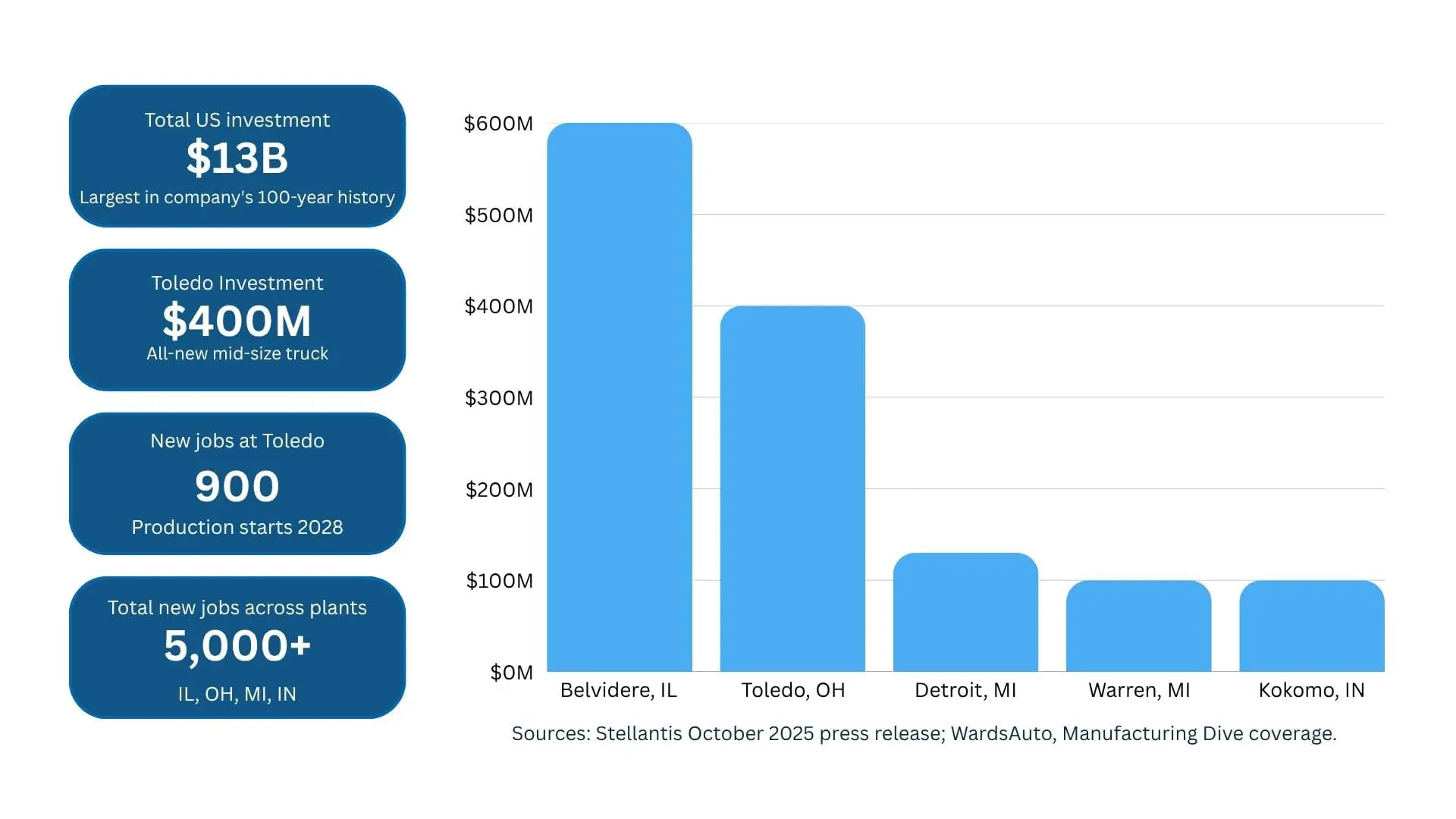
For Ohio’s automotive supplier base, this is more than a Toledo story. The truck program will ripple out through the Tier 1, Tier 2, and Tier 3 supplier ecosystem that already employs more than 680 businesses across the state directly or indirectly supporting auto assembly. Every new vehicle program means new harness designs, new crimp specs, new applicator setups, and new tooling demand. The shops that quote early and deliver on validation runs in 2026 and 2027 are the ones that win the production contracts in 2028.
Why a 2028 Launch Affects Your Tooling Decisions in 2026
Mid-size truck programs run on a development cadence that compresses every year. The 2028 production date means validation harnesses (test assemblies built to prove the manufacturing process before full production starts) are getting built in 2026 and 2027. Tier 1 suppliers are already quoting on harness assemblies, and Tier 2 contract harness shops are looking at the applicators (the machines that attach metal terminals to wire ends) they’ll need to deliver pilot runs.
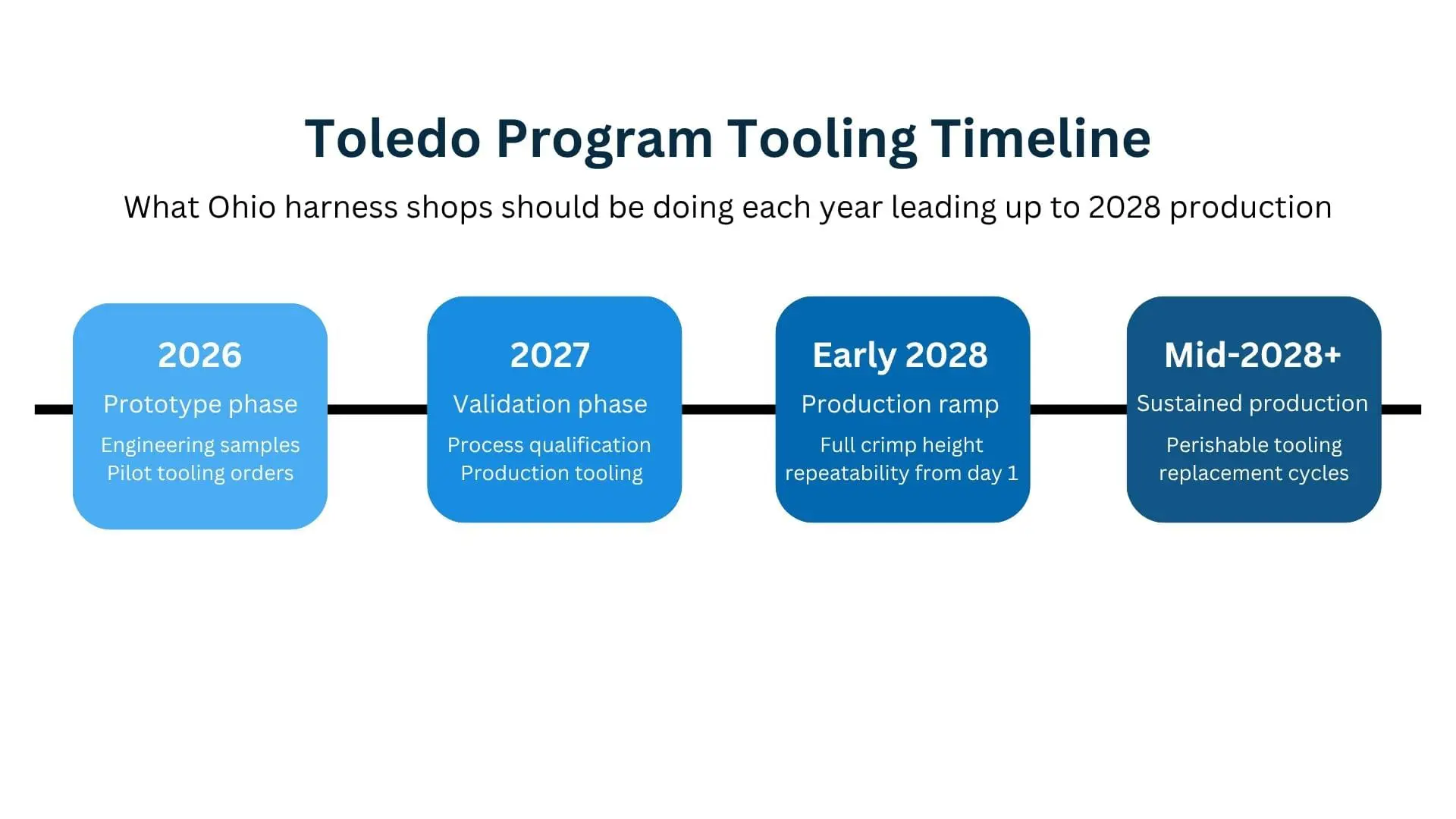
If you’re an Ohio harness shop preparing to quote on the Toledo program, the timeline looks roughly like this:
- 2026: Engineering samples and pilot tooling for prototype harnesses
- 2027: Process validation runs, applicator qualification, production tooling orders
- Early 2028: Production ramp begins, with full crimp height repeatability required from day one
- Mid-2028 onward: Sustained production, perishable tooling (the dies and punches that wear out and get replaced regularly) replacement cycles, ongoing engineering changes
The lead time on tooling from quote to qualified production runs is rarely a single transaction. It’s a series of orders for prototype dies, validation applicators, production tooling, and replacement perishable tooling that runs through the program’s full life. A supplier who delivers fast on the first quote becomes the default for the next four years of orders.
What Supply Chain Resilience Actually Looks Like on the Shop Floor
The automotive industry is rebuilding its supply chain from the ground up. The just-in-time model that defined auto manufacturing for three decades is being replaced by a hybrid approach that combines lean flow with targeted buffers, regional sourcing, and dual-supplier redundancy. The reasons are practical. A single missing part can shut down a line, and one hour of assembly downtime can cost millions of dollars.
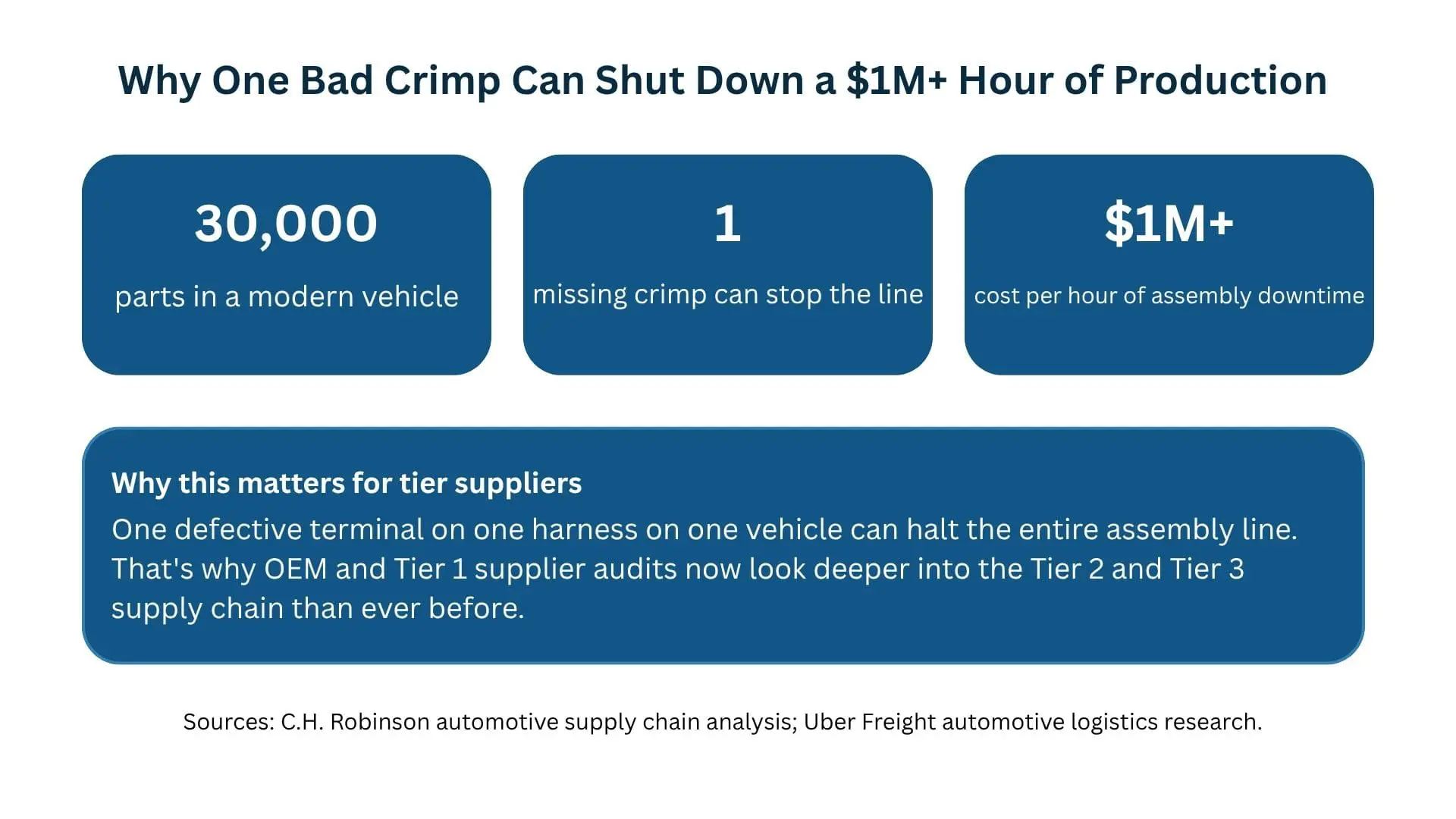
A few numbers explain why this restructuring is happening:
- A modern vehicle contains roughly 30,000 parts. Any one of them can stop production.
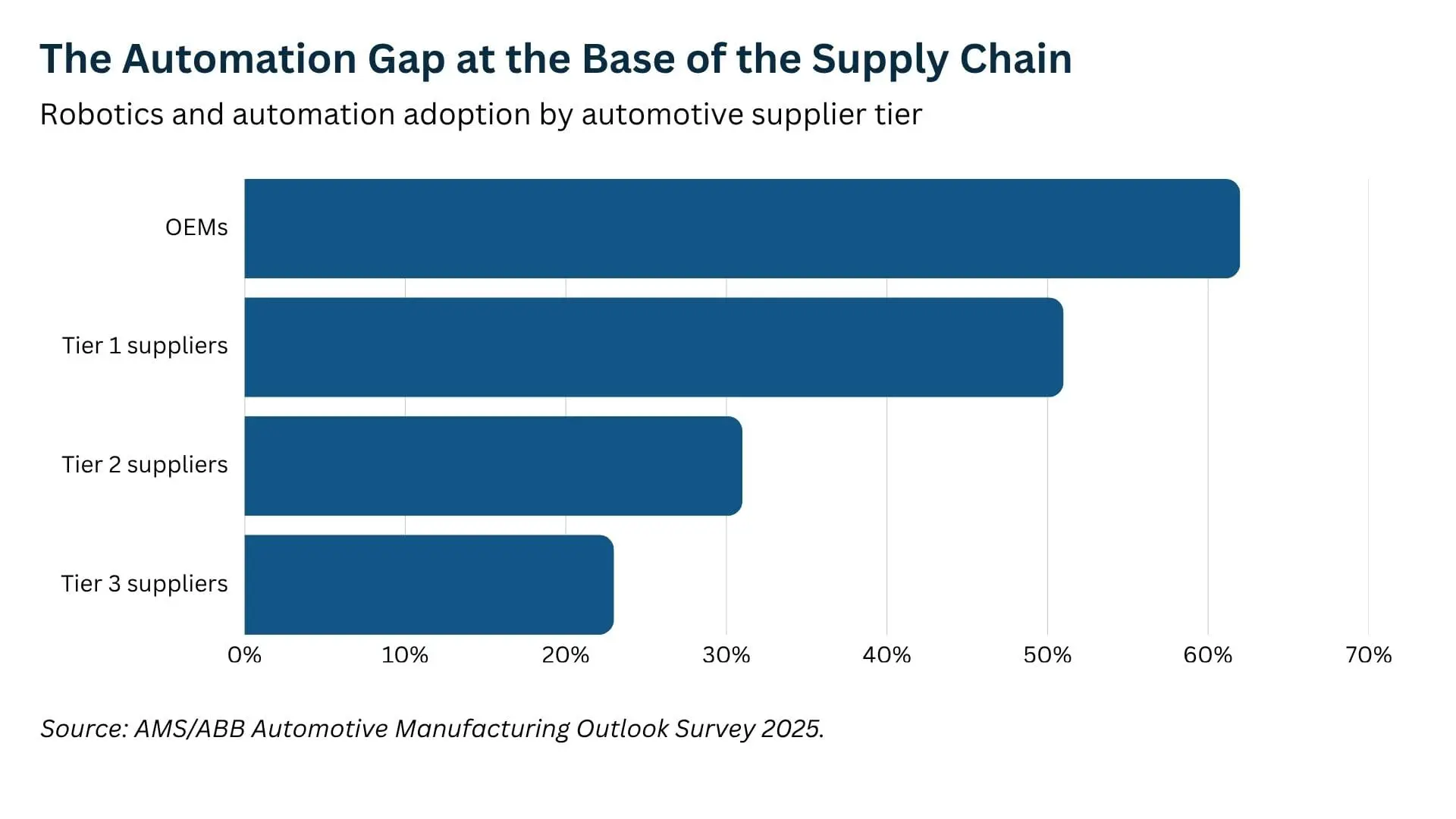
- Tier 1 automation adoption sits around 51% to 62%, but Tier 2 drops to 31% and Tier 3 to 23%. The base of the supply chain is the most fragile part.
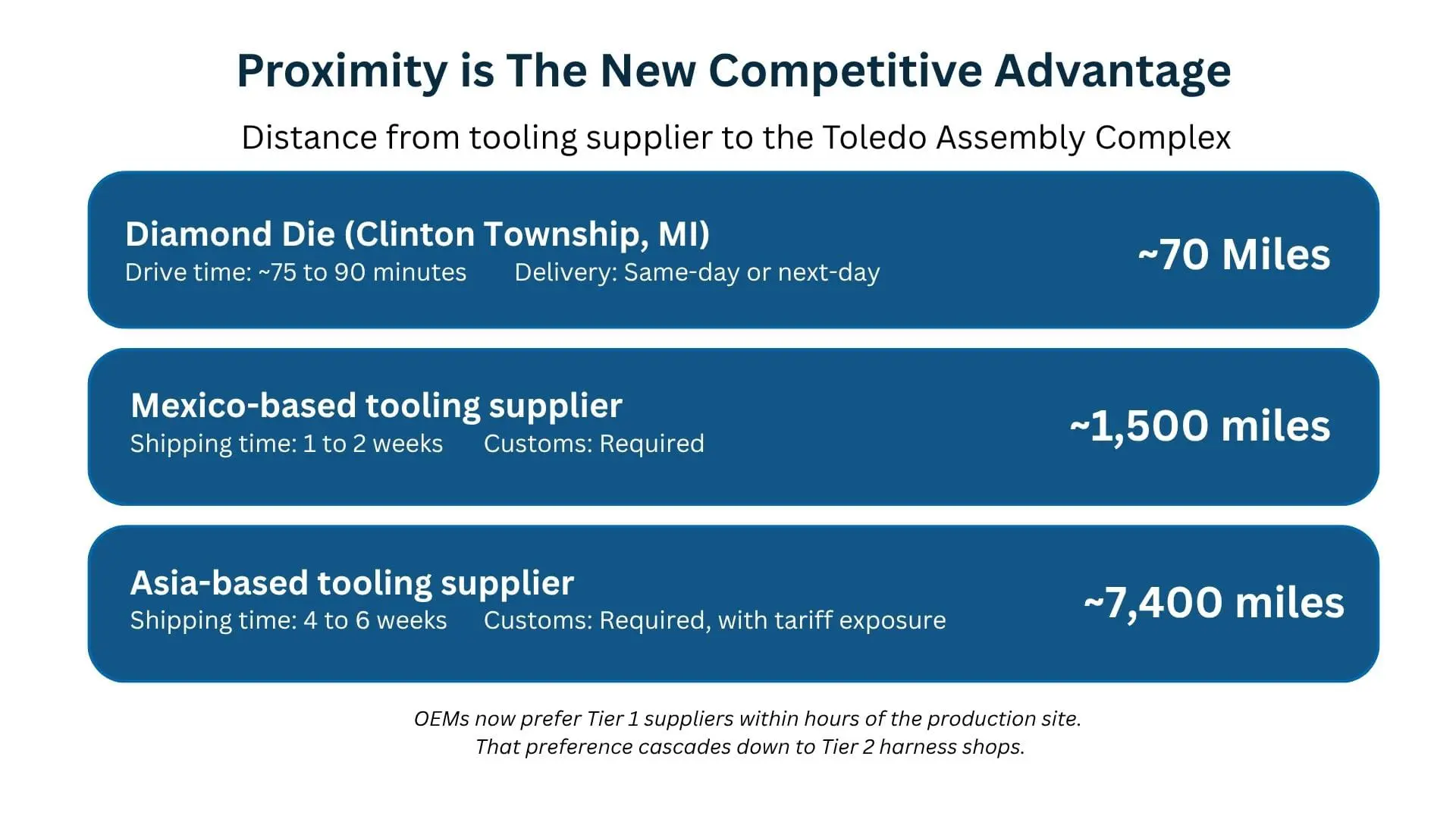
- OEMs now prefer Tier 1 suppliers within hours of the production site, not days or weeks away. Proximity has become a competitive advantage rather than a logistics detail.
- Supplier qualification cycles are getting tighter. OEMs are pulling apart their Tier 2 and Tier 3 supply chains looking for the hidden single points of failure that caused the 2021 to 2023 chip shortage.
For a Tier 2 harness shop quoting on the Toledo program, this restructuring shows up in three practical ways:
- Audit depth. Tier 1 customers are looking deeper into your supply chain than they used to. They want to know where your raw wire comes from, where your terminals come from, and where your tooling comes from. Documentation requirements have expanded from your shop floor outward.
- Single-source risk. If your applicator or perishable tooling comes from one supplier with a long lead time, your Tier 1 customer sees that as a risk to their line. Dual sourcing or stocking agreements that eliminate single-supplier dependency have become standard expectations.
- Lead time tolerance has shrunk. A 12-week tooling lead time used to be acceptable on a slow program ramp. Today’s program ramps don’t allow for it. Engineering changes happen mid-validation, and the tooling supplier who can respond in weeks wins the relationship.
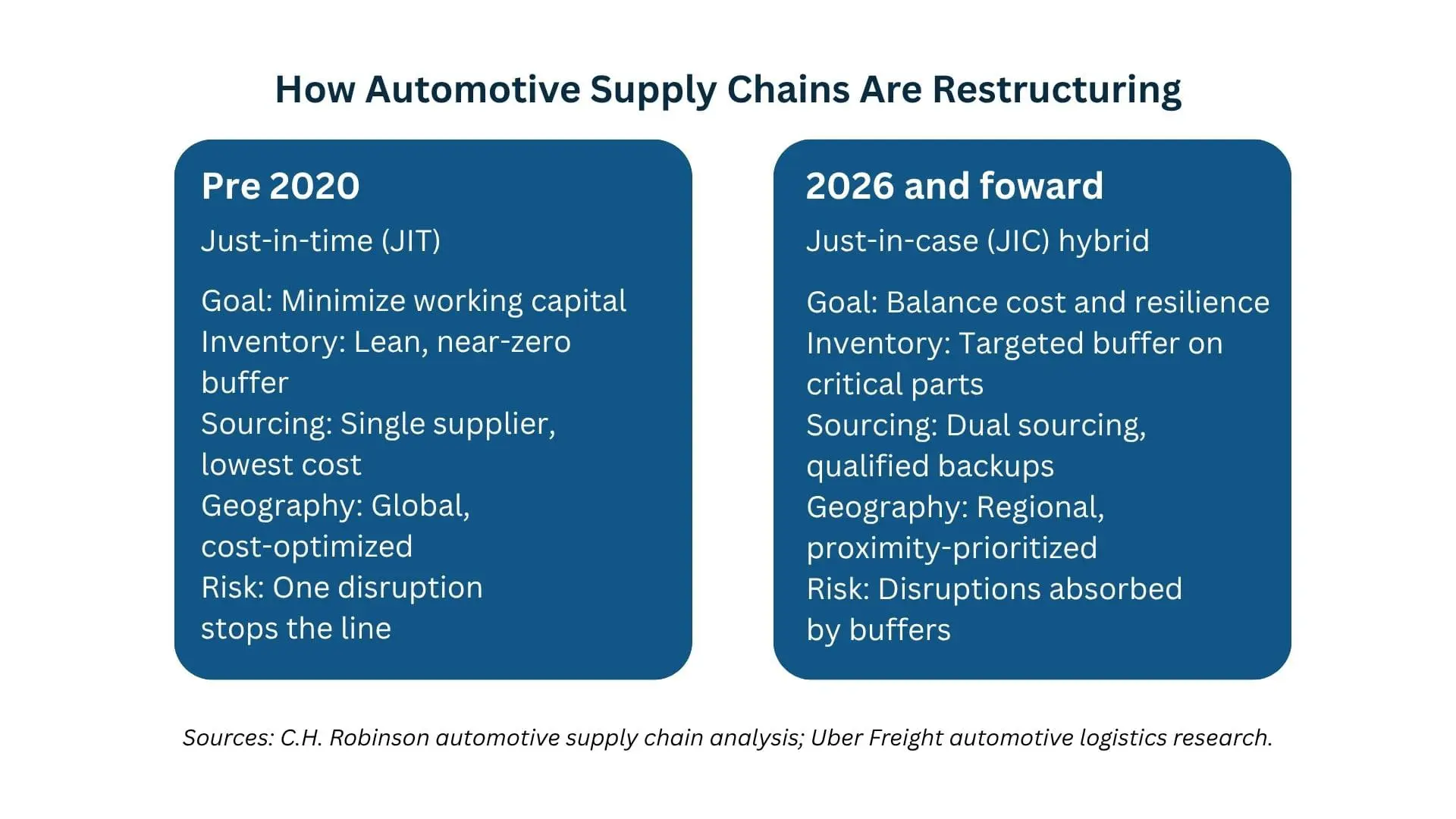
The OEMs and Tier 1s driving these changes are not asking suppliers to spend more on tooling. They’re asking suppliers to choose tooling partners who can move faster, document better, and stay close enough geographically to be reliable when something goes wrong. That’s the new shape of supplier qualification.
What’s Different About a Mid-Size Truck Harness
The all-new Stellantis mid-size pickup is being developed during a period of significant change in how vehicles are wired. Even though this is an internal combustion or hybrid program rather than a pure EV, the harness inside a 2028 truck has more sensors, more electronics, and more shielding than the model it replaces.
Three trends are shaping what Ohio harness shops will be building:
- More electronic content per vehicle. ADAS sensors (advanced driver-assistance systems like lane keeping, blind spot monitoring, and adaptive cruise control), infotainment, telematics, drive-by-wire, and electronic safety systems all add to harness complexity. A 2028 mid-size truck will carry more wire by length and more terminations per assembly than a 2018 equivalent.
- Tighter quality specs on every crimp. Recall costs and warranty exposure have pushed OEMs to demand IPC/WHMA-A-620 (the global standard for wire harness assembly acceptance) criteria across the harness, with cross-section validation (microscopic examination of a sliced crimp to verify internal compression) documentation tied to lot-level traceability.
- Mixed gauge ranges. Heavy-current power feeds for trailer towing and hybrid systems run alongside fine-gauge sensor signal lines on the same harness. Applicator setups have to cover the full range without crimp height drift.
The tooling that built a 2018 truck harness will not necessarily handle a 2028 truck harness. New programs are an opportunity to refresh applicator inventories and qualify replacement perishable tooling before production starts, instead of scrambling when the line is already running.
Northwest Ohio’s Tier Supplier Density Is a Real Advantage
Toledo sits at the center of Ohio’s automotive corridor, and the Tier supplier density in the region is one of the reasons Stellantis kept the program in Ohio in the first place. Northwest Ohio businesses can reach more than 60% of the US and Canadian markets within a day’s drive, and the state’s Tier 1, Tier 2, and Tier 3 supplier network covers nearly every phase of automotive production including tool and die, stamping, machining, harness assembly, and electronics.
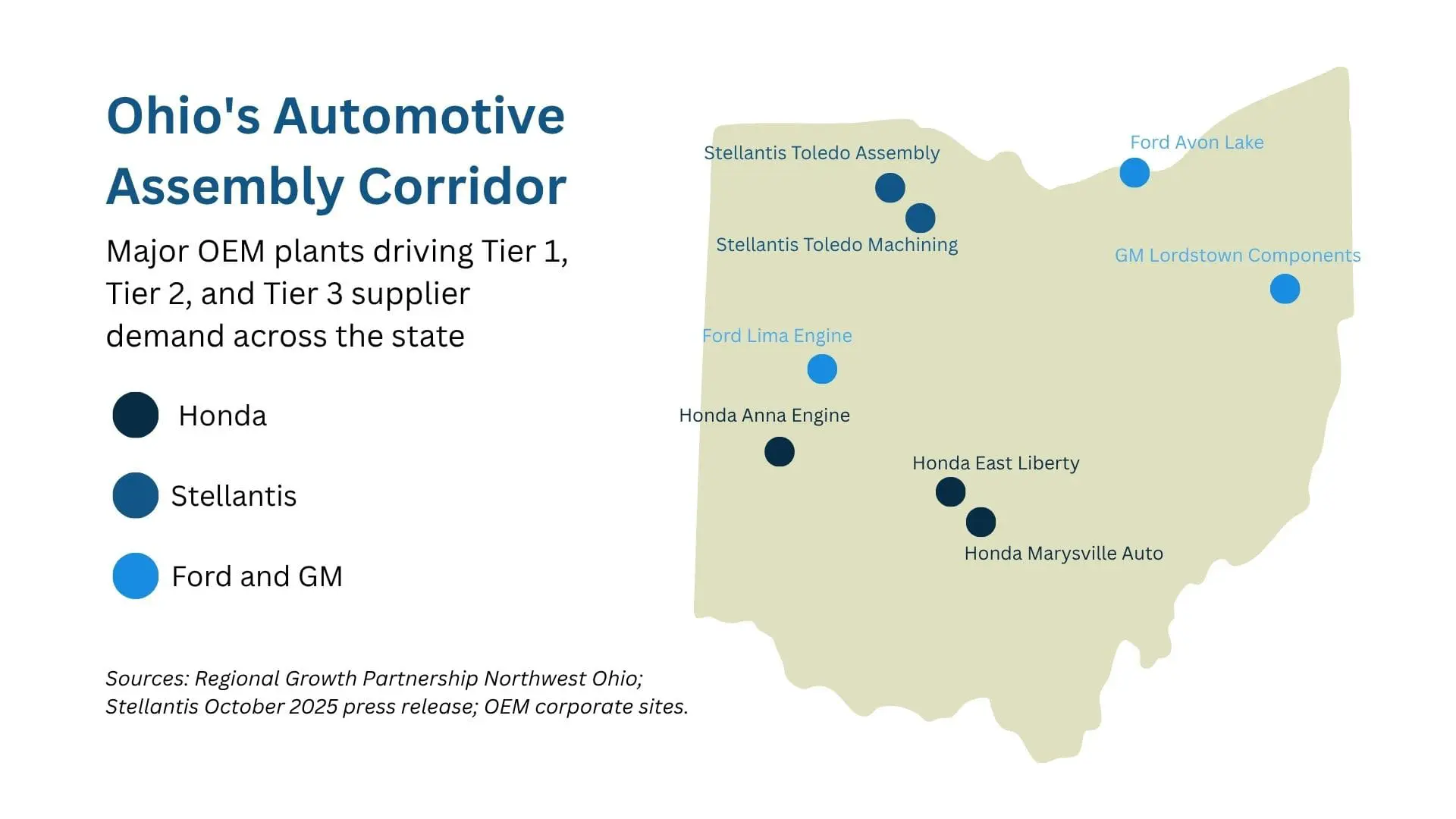
That density means a few things for harness suppliers quoting on the new truck program:
- Competition for OEM-direct work will be intense, with established Tier 1s in the area already positioned
- Tier 2 contract harness shops have an opportunity to specialize and capture niche assemblies (instrument panel harnesses, body harnesses, engine harnesses) where Tier 1 capacity is constrained
- The supplier ecosystem is connected, which means a shop that delivers well on one assembly program tends to get pulled into adjacent programs
What that ecosystem rewards is reliability and speed. Plants don’t have time to chase down tooling problems mid-shift. The harness shops that win sustained business are the ones whose applicators run consistently, whose perishable tooling gets replaced before it fails, and whose tooling supplier can quote and deliver in weeks instead of months.
What This Means for Tooling Procurement
For a Tier 2 harness shop quoting on the new Toledo program, the practical tooling questions to think through in 2026 and 2027 are:
- Can my current applicator setup handle the gauge range and shielding spec the OEM has on the print?
- If a die or applicator fails during a pilot run, how fast can I get a replacement?
- Does my tooling supplier carry documentation that supports the lot-level traceability my Tier 1 customer expects?
- If the OEM changes a terminal spec mid-program (which they will), can my tooling supplier reverse engineer or modify a die without a 12-week lead time?
- Am I holding enough perishable tooling inventory, or am I depending on my tooling supplier to ship within days?
A program ramp is the worst time to discover that your tooling supplier can’t keep up. The shops that establish strong tooling relationships during the 2026 pilot phase are the ones who don’t get blindsided in 2028.
The Offshore Tooling Risk on a Domestic OEM Program
Stellantis’s $13 billion investment is explicitly framed as a US manufacturing commitment. The Toledo program is being built in Ohio, with US labor, US supply chain commitments, and US investment incentives baked into the program structure. That domestic positioning extends down through the supplier chain.
For Tier 2 harness shops, depending on overseas tooling on a domestic OEM program creates exposure that’s worth thinking through:
- Six to eight week production lead times plus shipping and customs clearance don’t fit a pilot run timeline that’s measured in weeks
- Change notifications from overseas suppliers arrive late or not at all, which creates documentation gaps when the Tier 1 audits your processes
- IP and design data protection on a domestic vehicle program is harder to defend when tooling specs are sitting in an overseas shop’s ERP system
- Tariff exposure on tooling components has gotten more unpredictable, which makes total cost of ownership harder to forecast
A domestic tooling supplier with documented quality systems eliminates those exposure points. The unit price is higher. The total cost of ownership through a 4-year program is lower.
Where Diamond Die Fits
We’re a Michigan-based, ISO 9001 certified, women-owned small business that has built precision crimping tooling for seven decades. Our shop sits roughly an hour north of the Toledo Assembly Complex, which means same-day or next-day delivery on perishable tooling for Ohio harness shops is a logistics reality rather than a marketing claim.
Our reverse engineering process delivers a production-ready replacement applicator or die in under four weeks total, with Keyence precision measurement and CAD modeling that replicates worn or undocumented OEM geometry without requiring original prints. Our precision machining capabilities build tooling to ±0.0004 inch accuracy, with measurement capability down to ±0.0001 inches, which puts us in tolerance range for the kind of repeatable crimping that current mid-size truck harness programs require. Our crimp analysis service validates terminal and wire combinations against IPC/WHMA-A-620 acceptance criteria before production starts, with documentation that supports Tier 1 supplier audits.
Our stocking agreements are particularly relevant for program ramps like Toledo’s. Once we reverse engineer or build your applicator, we can hold inventory on your behalf and ship within 24 hours when you need replacements. For a 2028 production launch, that kind of stocked-and-ready relationship is what keeps a pilot run from slipping into a production miss.
If your Ohio harness shop is quoting on the Stellantis Toledo program, or any of the related Tier 1 assemblies coming out of the $13 billion investment, call us at (586) 791-0700. We’ll review your terminal specs, walk through your current applicator inventory, and tell you straight what you’ll need to deliver on validation runs in 2026 and 2027.