
Terminal Crimp
Cross Section Analysis
Precision Insights That Protect Your Production and Compliance
Send us your samples. Our engineers prepare, analyze, and report on each crimp, delivering detailed measurements and expert interpretation. No capital investment in analysis equipment required. No wait for internal QC lab queues. Just clear answers from the team that has been designing terminal crimping tooling for 70 years.
What We Measure
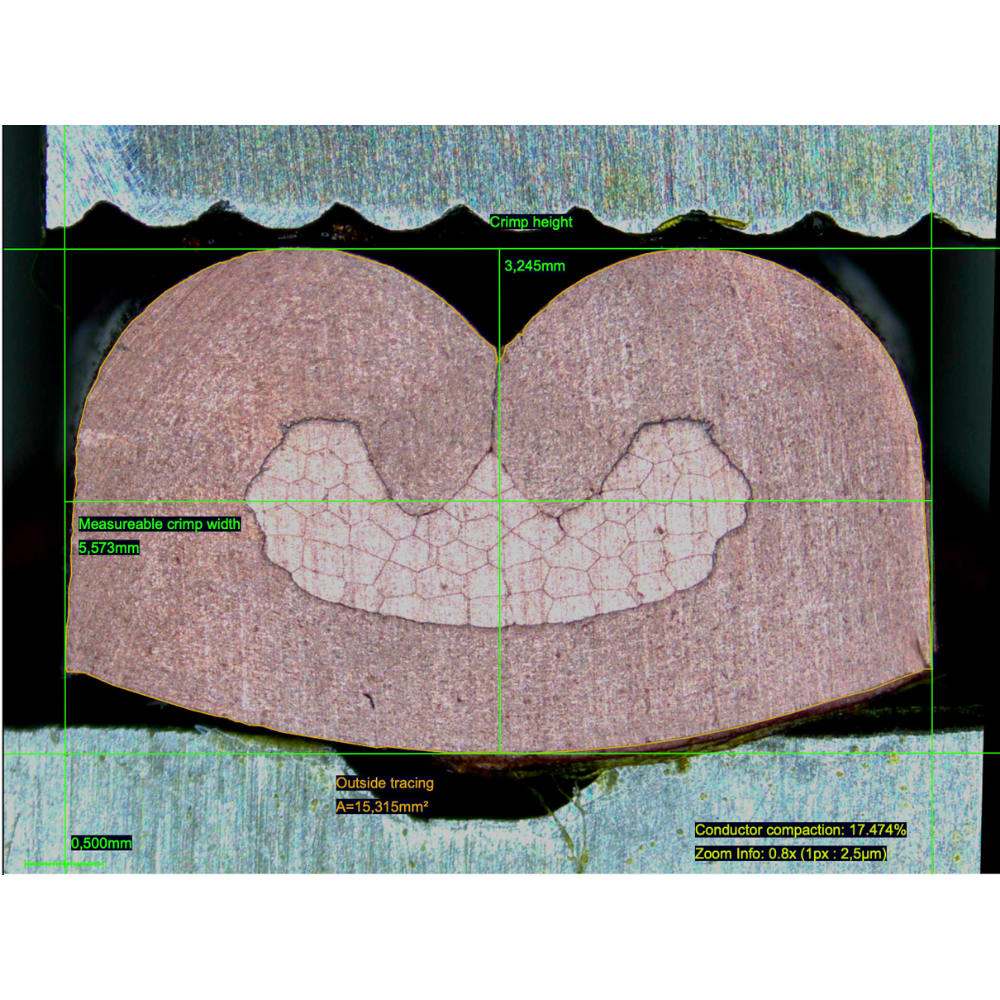
Every sample analyzed includes measurements of:
- Crimp height
- Crimp width
- Outside tracing area
- Inside tracing area
- Burr width
- Conductor compaction
- Strand count (limited in count due to size, as some cables have hundreds or thousands of strands).
These measurements give a complete picture of how the terminal has been compressed onto the wire and whether the crimp meets your specifications. Each measurement is documented in an individual sample report you receive after analysis.
Sample Range
Our system handles conductor sizes from 28AWG to 400 MCM.
Crimp Types Analyzed
We can analyze any style of crimp. Customer just needs to define dimensional and compaction requirements.
The Analysis Process
Step 1: Sample Preparation
Send us your crimped samples. Our team prepares each sample for analysis. We can analyze any style of crimp. Customer just needs to define dimensional and compaction requirements.
Step 2: Cross Section Analysis
Each sample is cut, polished, and imaged for cross section analysis. Our engineers measure the crimp geometry against specification tolerances and industry standards.
Step 3: Detailed Reporting
You receive an individual report for each sample analyzed, including all measurements, image documentation, and engineering interpretation of the results, if requested.
Turnaround:
1-3 weeks depending on workload and sample quantity.
Why Crimp Analysis Production Matters
Crimp cross section analysis confirms that your crimping process delivers what your specifications require. Specifically, it helps you:
- Confirm reliable wire-end crimps that will not fail in the field
- Reduce defects and rework by catching process issues before production scale
- Meet strict industry compliance standards
- Improve long-term product safety and performance
- Support automotive, EV, aerospace, medical device, and OEM manufacturing requirements
For manufacturers running high-volume production, this validation protects your reputation, your warranty exposure, and your customer relationships.
Built for the Industries
That Depend on Crimp Reliability
Automotive and EV
Manufacturing
Catches loose terminations, fatigued wires, and mismatches before they reach the production line, reducing warranty exposure on high-current battery systems and wiring harnesses.
Aerospace
Manufacturing
Confirms uniform compression, correct conductor brush configuration, and controlled crimp force for avionics, structural wiring, and mission-critical connections.
Medical Device
Manufacturing
Validates miniature crimps against spec, supporting the reliability and traceability requirements medical device teams face during audits.
Consumer Electronics and
Industrial OEMs
Catches wire pullout, contact resistance, and strand breakage risks before they affect field performance.
Why Choose Diamond Die & Mold for Crimp Analysis
Expert interpretation, not just automated measurements. Software gives you numbers. Our engineers tell you what the numbers mean for your production, if requested.
Applied crimping experience since 1956. Seven decades of designing the tooling that makes these crimps.
Full-loop support. If our analysis identifies a tooling issue, we can build the replacement.
Woman-Owned Small Business and ISO 9001 certified. Supports federal contract, aerospace, and medical device audit requirements.
Direct access to our engineering team. No sales layers, no chatbots, no wait.

Compliance and Industry Standards
Every analysis report includes the measurements, images, and documentation needed to support your quality audits and regulatory reviews.
Our standard report format references SAE/USCAR-21, the industry standard for automotive electrical terminal performance requirements. When your project requires a different format, our analysis system also supports OEM-specific report templates for VW, Bosch, PSA (Stellantis), Renault, Fiat, and other major manufacturers.
If your compliance requirement isn’t listed, contact our team. We can confirm which format best fits your project before you send samples.
What to Know About Crimp Cross Section Analysis
What is crimp cross section analysis?
How do I send samples for analysis?
What wire and terminal sizes can you analyze?
What does a completed analysis report look like?
Do you analyze crimps produced by other manufacturers' applicators and presses?
Can you help me fix problems the analysis identifies?
Explore Additional
Diamond Die & Mold Services
Crimping Applicators
Hi-Speed, Hydrofeed, and Heavy-Duty applicators matched to your terminal and production needs.
Crimping Presses
6-ton and 22-ton presses matched to your terminal and applicator setup.
Crimping Presses
6-ton and 22-ton presses matched to your terminal and applicator setup.
Perishable Tooling
High-precision replacement tooling built for repeat use in high-volume production.