Drones are changing the way the US military fights, and Texas is at the center of how those drones get built. The Pentagon’s FY2027 budget request earmarks $53.6 billion for autonomous drone platforms and contested logistics, with another $21 billion for munitions and counter-drone systems. The Defense Autonomous Warfare Group saw its budget jump from $225.9 million in FY2026 to a proposed $54.6 billion in FY2027, a more than 24,000% increase. The Drone Dominance Program plans to purchase over 200,000 industry-made drones by 2027.
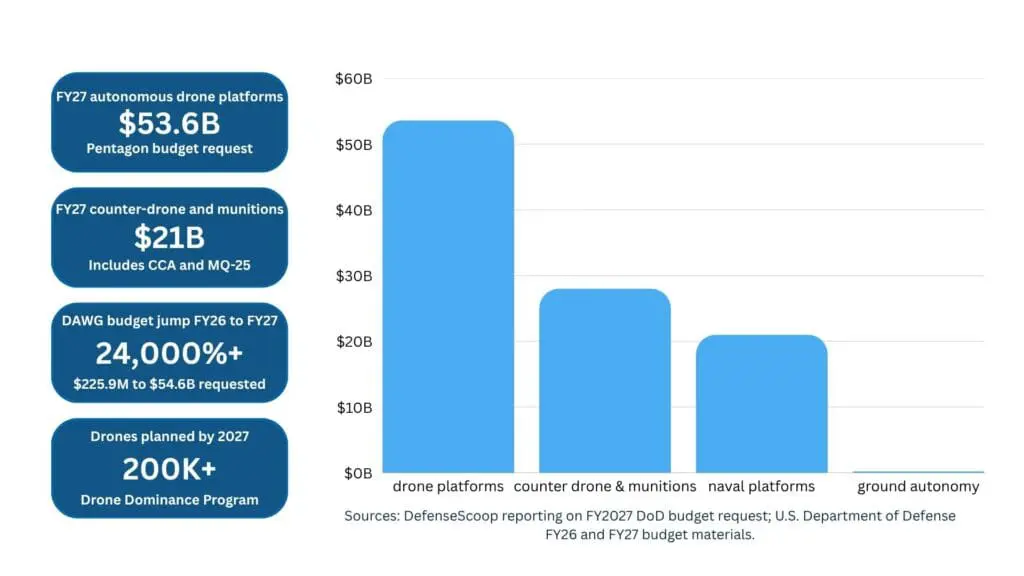
Caption: Sources: DefenseScoop reporting on FY2027 DoD budget request; U.S. Department of Defense FY26 and FY27 budget materials.
A large share of that work runs through Texas. Lockheed Martin Fort Worth builds the F-35 and is integrating autonomous mission systems into the program. Bell in Fort Worth is developing the next generation of vertical lift platforms. Boeing operates major facilities in San Antonio. SpaceX runs Starbase in Brownsville and produces Starlink hardware at scale. Army Futures Command is headquartered in Austin. Fort Cavazos, formerly Fort Hood, is the largest active duty armored post in the US and a primary site for autonomous ground systems training and procurement.
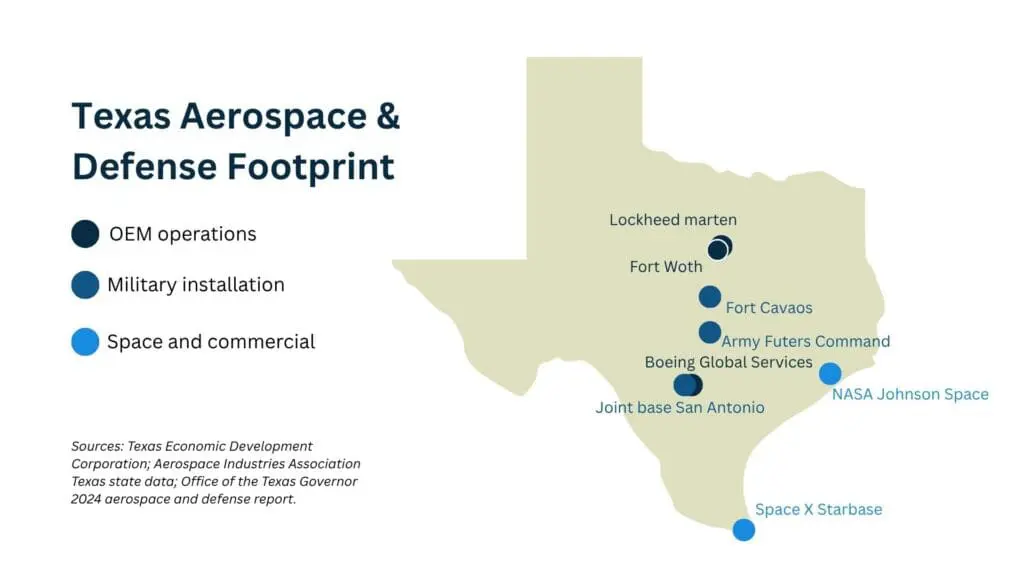
Caption: Sources: Texas Economic Development Corporation; Aerospace Industries Association Texas state data; Office of the Texas Governor 2024 aerospace and defense report.
Texas aerospace and defense employs more than 150,000 workers across 2,000+ establishments, with all eight Fortune 500 aerospace and defense companies operating in the state. What’s changing in 2026 is the kind of work those companies are doing, and what their Tier 2 and Tier 3 harness suppliers need to deliver.
The Wire Harness Inside an Autonomous Platform Is Not the One You Built in 2020
A UAV (unmanned aerial vehicle), UGV (unmanned ground vehicle), or counter-drone system is a flying or rolling sensor network. AI targeting, autonomous navigation, swarm communications, electronic warfare countermeasures, and live data relay all run on dense, shielded, mission-critical wire harnesses. The crimping requirements look more like a satellite than a passenger truck.
Three things change when a harness shop moves from legacy defense work to current autonomous platforms:
- Mission-critical pull-force specs. A crimp failure in a manned aircraft has redundancy. A crimp failure in a small attritable drone means the platform is lost. The DoD’s Drone Dominance program emphasizes affordability, but the acceptance criteria for the harnesses inside those platforms are still tight. Pull-force testing per IPC/WHMA-A-620 (the global standard for wire harness assembly acceptance) and AS9100 (the aerospace quality management standard) is non-negotiable.
- EMI shielding everywhere. Autonomous systems run RF datalinks, GPS, electro-optical sensors, and high-current motor drives in the same airframe. Shielded crimps (terminals that maintain a continuous conductive layer around the wire to block electromagnetic interference), drain wire terminations, and continuous shield integrity from connector to connector are no longer optional. They’re baseline.
- Fine-gauge signal lines and heavy-gauge power on the same platform. A drone or UGV harness might run 30 AWG sensor wires next to 8 AWG battery feeds. A general-purpose applicator (the machine that attaches metal terminals to wire ends) setup doesn’t cover that range. Operators need different press and die configurations for each gauge, often switching between them multiple times per build.
The applicator and die selection that worked on a 2015 helicopter wiring program will not handle a 2026 autonomous platform harness without modification, replacement, or both.
Counter-Drone Systems Add Another Layer
While drone production scales up, the counter-drone side is expanding just as fast. Anti-UAV systems include radar arrays, RF jammers, kinetic interceptors, and directed-energy weapons. Each system has its own electrical signature and harness density. Counter-drone harnesses often combine high-current pulse circuits with sensitive signal lines, which raises the EMI management problem and tightens the requirement for clean, repeatable shielded crimps.
Texas hosts a significant portion of the counter-drone industrial base. Major primes and emerging specialty firms operate facilities in Dallas-Fort Worth, San Antonio, and Austin. For harness builders supporting those programs, the tooling has to handle both sides of the drone-vs-counter-drone equation, sometimes within the same week and the same shop.
Tooling Is One Piece of a Program-Wide Supply Chain
An autonomous defense platform isn’t built by one supplier. The cast aluminum housings on a UAV guidance unit come from investment casting shops. The precision-machined brackets come from CNC houses. The wire harnesses inside come from contract harness builders. The crimp tooling that terminates those harnesses comes from a specialized tooling supplier.
What ties these together for a defense prime contractor is whether the entire chain can document traceability, hold to AS9100 alignment, and ship from US soil under ITAR (International Traffic in Arms Regulations, the US law governing export of defense-related technical data). Tooling sits at the end of that chain. If the applicator can’t deliver consistent crimps that meet pull-force specs on shielded mil-spec wire, the harness fails inspection, and the program slips regardless of how well the cast housing and machined bracket were made.
Our role in that chain is specific and we own it: the crimping tooling, the perishable dies (the components that wear out and get replaced regularly), the cross-section analysis (microscopic examination of a sliced crimp to verify internal compression and strand contact), and the documentation that makes the harness portion of the assembly auditable for an aerospace or defense buyer.
What ITAR and Domestic Sourcing Actually Require
The DoD’s emphasis on domestic manufacturing for autonomous systems is not a marketing preference. It’s a contractual requirement on most programs. The Drone Dominance Program’s “Blue Lists” of approved vendors, the Defense Autonomous Warfare Group’s procurement framework, and the broader CMMC 2.0 (Cybersecurity Maturity Model Certification, the DoD’s framework for protecting controlled unclassified information) cybersecurity certification regime all push primes toward suppliers who can:
- Demonstrate US-based production with documented chain of custody
- Maintain ITAR-aware operations for export-controlled technical data
- Hold AS9100 or ISO 9001 quality system certification
- Produce traceability records that survive a prime contractor audit
- Ship without customs delays or cross-border IP exposure
For Texas harness suppliers quoting on autonomous defense work, those requirements extend to every supplier in their chain, tooling included. An applicator built in Asia, shipped through customs, and delivered with limited documentation creates friction the prime contractor doesn’t want to see in a supplier qualification review.
The Pace of Acquisition Has Changed
The DoD has publicly said it wants to move autonomous systems “in a timeframe of weeks, not years.” The Drone Dominance Program is purchasing 30,000 drones for delivery by July 2026, with another 50,000 to 60,000 planned for August. This is a different procurement rhythm than the F-35 program or the Patriot system.
For harness builders, that compressed timeline shows up as quote-to-production windows measured in weeks instead of quarters. A tooling supplier with an 8-week lead time and a customs clearance step doesn’t fit. A supplier who can reverse engineer a worn die in a week, deliver a precision replacement in four weeks total, and hold inventory on stocking agreements does.
Our precision machining and reverse engineering capabilities support that pace. We can take a worn or undocumented applicator component, measure it with Keyence precision scanning, and deliver a production-ready replacement within four weeks. We build tooling to ±0.0004 inch accuracy, with measurement capability down to ±0.0001 inches, which puts us in range for the kind of repeatable, low-drift crimping that mil-spec harness work requires.
What Texas Harness Builders Should Be Asking Their Tooling Supplier
If your shop is quoting on a UAV, UGV, counter-drone, or missile defense program, the practical questions for your tooling partner are:
- Can you build or modify applicators for the gauge range we need, from 30 AWG signal lines to heavy-gauge power conductors?
- Do you have experience with shielded crimp terminations, including drain wire and foil-shield management?
- Can you run cross-section analysis on our specific terminal and wire combination before we put the applicator into production?
- Are you US-based, with no offshore manufacturing or customs exposure in your supply chain?
- Can you provide the documentation our prime contractor will ask for in a supplier qualification review?
- What’s your turnaround on a replacement die or perishable tooling when a program goes into validation runs?
A tooling supplier that handles automotive volume but has never quoted on a defense harness will struggle on the second and third questions. A supplier without a US footprint will struggle on the fourth. A supplier without ISO 9001 certification and traceable records will struggle on the fifth.
Where Diamond Die Fits
We’ve built precision crimping tooling for seven decades. We’re ISO 9001 certified, women-owned small business designated, and 100% US-based out of our Clinton Township, Michigan facility. Our reverse engineering process delivers production-ready tooling in under four weeks, with Keyence precision measurement and CAD modeling. Our crimp analysis service validates terminal and wire combinations against IPC/WHMA-A-620 acceptance criteria before production starts. Our stocking agreements protect your line from the kind of delay that turns a 4-week program slip into a 12-week miss.
We support the harness portion of autonomous defense programs without overreaching. We don’t cast, we don’t machine structural housings, and we don’t assemble platforms. What we do is the precision tooling that makes the crimps inside those platforms reliable, repeatable, and audit-ready.
If your Texas harness shop is quoting on autonomous defense work, missile defense components, counter-drone systems, or any aerospace program with shielded mil-spec wire termination, call us at (586) 791-0700. We’ll review your terminal specs and tell you straight whether the applicator you have can handle what’s coming.