Surgical robots are everywhere in California right now. Intuitive Surgical installed 395 of its da Vinci systems in Q2 2025 alone, including 180 of the new da Vinci 5 units the FDA cleared earlier that year. Medtronic’s Hugo robotic surgery system got its FDA clearance. Johnson & Johnson started clinical trials for its OTTAVA platform. The medical robots market is on track to hit $64 billion by 2034.

Most of that engineering and manufacturing happens in California. Intuitive Surgical is headquartered in Sunnyvale. A wave of Bay Area startups is building autonomous surgical robots, microsurgery platforms for eyes and nerves, and AI-guided systems that combine real-time imaging with robotic precision. Orange County and San Diego are layering wearable diagnostics on top of that, with continuous glucose monitors, stroke-detecting headbands, and at-home diagnostics now FDA-cleared and shipping nationwide.
What that means for harness builders and contract manufacturers supplying these programs is simple. The crimping work has gotten harder.
Smaller Devices, More Connections, Tighter Specs
A surgical robot is a wire-density problem in a robotic enclosure. The da Vinci 5 carries more sensors, more articulating joints, and more data channels than the previous generation. Each joint has feedback loops. Each sensor needs shielded signal pairs (paired wires wrapped in a conductive layer that blocks electromagnetic interference). Each end-effector swap means a connector cycle. The harness inside is denser, smaller-gauge, and more shielded than anything an automotive crimp shop is used to running.

Source: AWG standard. Diameters shown at relative scale.
Three things change when you move from a hospital monitor or infusion pump to a surgical robotic harness:
- Wire gauge gets smaller. Robotic instrument harnesses routinely use 28 to 32 AWG for signal lines, and sometimes finer. Most general-purpose applicators (the machines that attach metal terminals to wire ends) are not set up to handle that range without crimp height drift. Hi-speed applicators built for fine-gauge work are a different class of tooling.
- Shielding becomes standard. Electromagnetic interference inside a robotic arm next to a high-frequency electrosurgical generator is a real problem. Shielded crimps, drain wire terminations, and foil-wrapped bundles are now baseline, not premium.
- Pull-force specs tighten. A surgical instrument that fails mid-procedure is a patient safety event. The acceptance criteria for crimp pull strength on a robotic instrument harness are tighter than on a passenger car harness, and the inspection documentation has to prove it on every unit.
The applicator and die selection that worked for a Class II monitor program ten years ago will not handle a current-generation robotic instrument harness. The tooling has to change with the device.
Why Tolerances Matter More Than Ever
Surgical robotic harnesses, fine-gauge wearable connections, and miniaturized implantable devices all share one requirement: the tooling that makes them has to hold tolerance over thousands of cycles without drift. A die that’s within tolerance on day one and 0.002 inches out by week six is producing crimps that pass on the inspection bench and fail in the field. In a production environment, crimp tolerances typically can’t be held any tighter than ±0.002 inches, which makes the tooling that produces them the variable that matters most.
Our reverse engineering and precision machining services build tooling to ±0.0004 inch accuracy, with measurement capability down to ±0.0001 inches. That’s the level of precision that next-generation medical device tooling actually needs. At that tolerance, a Keyence scan can replicate a worn or undocumented OEM die geometry exactly, and the replacement applicator runs the same crimp profile as the original on cycle one and cycle one million. For California harness builders supporting surgical robotic programs in validation, that’s the difference between a Device Master Record (the FDA-required documentation that defines how a device is manufactured) that holds up under FDA scrutiny and one that doesn’t.
Wearables Are Pushing the Other Direction
While surgical robots demand denser, more shielded crimping, the wearables side of California medtech is pushing toward miniaturization for a different reason. Dexcom’s Stelo continuous glucose monitor became the first FDA-cleared over-the-counter CGM in the US, and roughly 36% of US adults reported using a healthcare wearable in 2025. Stroke-detection headbands, at-home cancer screening devices, and connected biosensors are moving from concept to FDA clearance at a pace that’s putting pressure on the supply chain underneath them.
These devices need crimps that survive flex cycles, skin contact, sweat exposure, and the occasional washing machine. The crimping standards differ from a surgical instrument, but the precision requirement is just as high. A wearable that drops out mid-use because of a fatigued terminal connection erodes the clinical data the device exists to capture.
What Harness Builders Should Be Asking Their Tooling Supplier in 2026
If your shop is quoting on a next-generation surgical robotic program or a wearable diagnostic device, the questions to ask your tooling supplier are practical:
- Can you build or modify applicators for fine-gauge wire below 28 AWG without sacrificing crimp height repeatability?
- Do you have experience with shielded crimp terminations, including drain wires and foil-shield management?
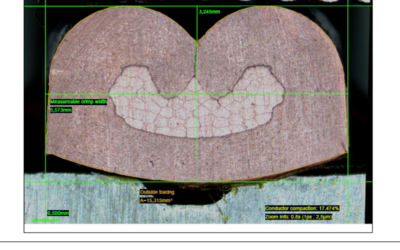
- Can you run cross-section analysis (microscopic examination of a sliced crimp to verify internal compression and strand contact) on our specific terminal and wire combination before we put the applicator into production?
- What’s your turnaround on a replacement die or perishable tooling (the dies and punches that wear out and get replaced regularly) when a robotic program goes into validation runs?
- Can you reverse engineer a legacy die when the original OEM source is gone, and how tight a tolerance can you hold on the replacement?
A tooling supplier that handles automotive volume but has never quoted on a robotic instrument harness will struggle on the first two questions. A supplier that does medical work but ships from overseas will struggle on the fourth and fifth.
The Real Bottleneck Is Lead Time
The California medical device industry is moving faster than its supply chain in 2026. New device clearances are landing every month. Production validation runs are getting compressed. Engineering changes mid-program are the norm, not the exception. The harness shops that win these programs are the ones whose tooling partners can quote in days and deliver in weeks.

Source: Diamond Die & Mold operational data. Offshore figures based on typical published lead times for medical-grade tooling.
An offshore tooling supplier with a six to eight week lead time and a customs clearance step in the middle is not a fit for a robotic program in its validation phase. A domestic supplier who can reverse engineer a worn part in one week, deliver a precision replacement within four weeks total, and hold inventory on stocking agreements is.
Where Diamond Die & Mold Fits
We’ve built precision tooling for medical device customers for seven decades, and we’re ISO 9001 certified with a women-owned small business designation. Our reverse engineering process delivers a fully reverse-engineered, production-ready replacement in under four weeks, with Keyence precision measurement and CAD modeling that replicates OEM geometry without requiring original prints. Our precision machining capabilities build tooling to ±0.0004 inch accuracy, with measurement capability down to ±0.0001 inches, which puts us in the tolerance range that surgical robotic and miniaturized medical device tooling actually requires. Our crimp analysis service validates terminal and wire combinations against IPC/WHMA-A-620 (the global standard for cable and wire harness assembly acceptance) before production starts, with documentation suitable for your Device Master Record. Our stocking agreements protect your line from the kind of delay that turns a 4-week validation slip into a 12-week program slip.
If your team is quoting on a surgical robotic program, a wearable diagnostic device, or any next-generation medical device with shielded or fine-gauge crimping requirements, call us at (586) 791-0700. We’ll review your terminal specs and tell you straight whether the applicator you have can handle what’s coming.